Endoscopic Brow Lift in Istanbul, Turkey: Procedure, Recovery, Risks & Cost
When facial ageing begins, the changes are most often noticed first around the eyes. The downward displacement of the eyebrows, heaviness in the upper eyelids and prominent lines on the forehead can give a person a tired appearance, making them look older than they are.
Many patients ask whether they would benefit more from eyelid surgery or a brow lift. There is no single answer. The position of the eyebrow, the forehead, the eyelids and the surrounding facial structures need to be assessed together. In some patients the main concern is excess eyelid skin, while in others the downward position of the eyebrow is the more important factor. An endoscopic brow and forehead lift is one of the most modern surgical methods used to naturally restore this balance in suitable patients.
This article provides general information for patients considering an online consultation. It does not determine whether the procedure is suitable for you, and it does not replace an in-person medical assessment.
What Is an Endoscopic Brow Lift (Forehead Lift)?
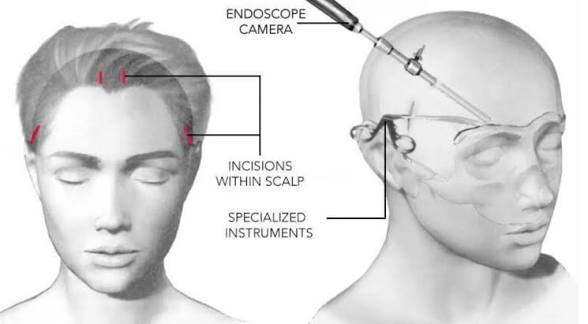
An endoscopic brow and forehead lift involves evaluating and repositioning the tissues in the forehead and brow area with the help of a small camera, called an endoscope, inserted through small incisions made within the scalp.
The endoscope provides a magnified view of the surgical field, helping the surgeon protect tissues, nerves and anatomical planes with high precision. The goal is to bring the eyebrow to a rested and natural-looking position that suits the patient’s face. An excessively elevated, “surprised” expression is never targeted.
Who Is a Candidate for Endoscopic Brow Lift in Istanbul?
An endoscopic brow lift may be discussed when a patient has concerns such as:
- A lower or heavy-looking brow, particularly in the outer brow
- A tired appearance around the upper eyes
- Early or moderate changes in the forehead and upper face
- Forehead or glabellar lines that may be affected by brow position and muscle activity
- A wish for a subtle, proportionate change rather than a dramatic alteration
The procedure may not address every concern around the eyes. Excess upper-eyelid skin, significant eyelid-bag changes, marked forehead laxity or more extensive facial ageing may require a different procedure or a combined plan. Suitability can only be determined after an individual assessment.
How Is Endoscopic Brow Lift Surgery Performed?
The exact approach varies according to the patient’s anatomy, hairline, tissue position, skin quality and goals. The main stages may include the following.
1. Incisions and Access Points
The surgery is usually performed through four small incisions, each 2 cm or shorter, located within the scalp. The placement of these incisions is specially modified according to the patient’s hairline and anatomical structure.
Because the incisions remain within the scalp, they are designed not to leave a visible scar on the outside. As with any surgery, however, scar healing and hair or scalp changes can vary between patients and should be discussed during consultation.
2. Dissection and Tissue Release
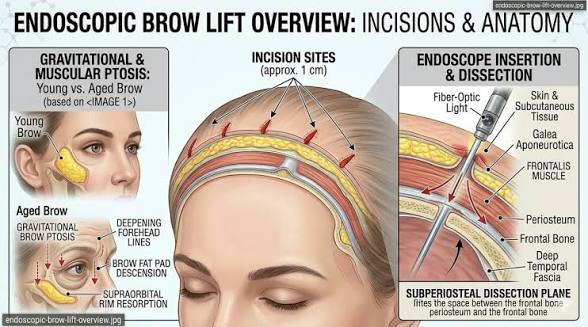
The most critical stage of the surgery is releasing the tissues in the forehead and brow area in the correct surgical plane. The dissection is performed under endoscopic camera guidance to protect the supraorbital nerve, which provides sensation to the forehead. Depending on the patient’s anatomy, subperiosteal or subgaleal planes may be preferred.
The muscles that pull the eyebrow down in the glabellar region, including the corrugator and procerus, may be weakened, allowing the eyebrows to move upward. The appropriate plane and extent of treatment vary between patients; there is no single technique that is right for everyone.
3. Repositioning and Fixation
After the brow and forehead tissues have been brought to the desired position, a fixation process is applied to maintain this new position during healing. Although various methods are described in the literature, one of the most reliable and successful methods for maintaining long-term brow stability is cortical tunnel, or bone tunnel, fixation. In this technique, the tissues are secured in their new positions using sutures passed through millimetric tunnels drilled into the bone.
Fixation is intended to provide long-term stability, but it cannot stop the natural ageing process. Scientific studies show that endoscopic brow lift surgery performed with accurate dissection and strong fixation methods can provide measurable and satisfactory longevity, although individual results vary.
Endoscopic Brow Lift vs Upper Blepharoplasty
An endoscopic brow lift and upper blepharoplasty address different areas, although they may sometimes be considered together. A brow lift changes the position and shape of the eyebrow and forehead tissues. Upper blepharoplasty focuses on excess upper-eyelid skin and, where appropriate, other eyelid changes.
When the upper eyelid looks heavy, the cause may be brow position, eyelid skin or a combination of factors. A detailed assessment helps determine whether brow lift surgery, eyelid surgery or a combined plan is more appropriate.
Endoscopic Brow Lift Recovery: What to Expect
Swelling, bruising, tightness and temporary changes in sensation may occur after surgery. The early recovery period varies according to the technique, the patient’s general health and the body’s healing response.
Many patients need approximately 7–14 days before returning to normal social or work activities, although the timing depends on the individual and the type of work involved. The brow can continue to settle and scars can continue to mature over the following months. Your surgeon will provide personalized instructions about washing the hair, exercise, sleep position, wound care and follow-up.
How Much Does Endoscopic Brow Lift Surgery Cost in Istanbul?
The cost of an endoscopic brow lift in Istanbul depends on the surgical technique, the complexity of the case, the hospital or facility, anaesthesia, the surgeon’s plan, postoperative care and whether another procedure is appropriate.
A responsible price can only be discussed after understanding the patient’s anatomy and proposed treatment plan. Patients should ask what is included in any quoted price, including hospital fees, anaesthesia, medications, follow-up and care if they return home after surgery.
Endoscopic Brow Lift Results: How Long Do They Last?
The aim is to create a rested, natural-looking and balanced upper face. The result develops as swelling settles and the tissues heal. Natural ageing continues after surgery, so no technique can guarantee a permanent appearance.
Individual longevity depends on factors including anatomy, skin quality, tissue behaviour, lifestyle and the fixation method used. The surgical plan should focus on a result that suits the patient’s face rather than on a fixed numerical promise.
Endoscopic Brow Lift Risks and Safety
All surgery carries risks. Depending on the procedure and the individual patient, these may include bleeding, infection, swelling, changes in sensation, asymmetry, hair or hairline changes, visible scarring, nerve-related problems, wound-healing problems and the possibility of revision surgery.
Before making a decision, discuss the expected benefits, alternatives, risks, anaesthesia, the surgical setting, postoperative monitoring and the follow-up plan with your surgeon. A consultation should also clarify what the procedure is not expected to improve.
Endoscopic Brow Lift FAQs for International Patients
How does the process work before travelling to Istanbul?
The process may begin with an online consultation. Patients can share clear photographs, their concerns, relevant medical information and their goals. This allows the team to discuss whether an in-person assessment may be appropriate and what information is still needed.
An online consultation does not replace a physical examination. The final treatment plan and suitability for surgery can only be confirmed after an appropriate medical assessment.
How is travel planning handled?
Istanbul is a global hub with direct flights from many parts of the world. For international patients, airport transfers, hospital transportation and accommodation processes can be coordinated by the clinic team. English communication support can be provided throughout the medical journey, with the exact arrangements explained before travel.
How long should I stay in Istanbul?
A stay of 7–10 days in Istanbul is generally sufficient to complete the preoperative examination, the surgical procedure and the early postoperative check-ups. The appropriate length of stay still depends on the patient and the surgeon’s advice, so do not arrange a return flight until the surgical team has confirmed that travel is appropriate.
When can I fly home?
After confirming that your healing is progressing healthily, a “fit to fly” approval is usually given 7–10 days after surgery. Medical advice such as using compression stockings and drinking plenty of fluids during long flights will be shared with you when appropriate.
Will there be a scar, and can stitches be removed at home?
In the endoscopic technique, the incisions remain hidden inside the scalp and are generally not noticeable from the outside once healed. The sutures used are generally removed after 7–10 days. If you return to your country early, the necessary guidance will be provided so your stitches can be removed by a healthcare professional in your home country.
If you plan to return home before the sutures are removed, confirm in advance which healthcare professional should provide the follow-up and how the surgical team will remain involved.
Will the result look natural?
The philosophy is to provide natural rejuvenation with a “ghost surgery” approach without distorting facial proportions. Elevating the outer brow more than necessary or disrupting the anatomical balance can cause an artificial appearance. The aim is therefore a more rested and energetic appearance rather than a face that looks obviously operated on.
Is an endoscopic brow lift permanent?
Scientific studies show that endoscopic brow lift surgery performed with accurate dissection and strong fixation methods, such as cortical tunnel fixation, can provide measurable and satisfactory long-term longevity. Although natural ageing continues, the tissues do not necessarily completely revert to their preoperative state. Individual results and longevity vary.
References and Further Reading
- Cleveland Clinic: Forehead/Eyebrow Lift
- American Society of Plastic Surgeons: Brow Lift Procedure
- American Society of Plastic Surgeons: Brow Lift Recovery
- American Society of Plastic Surgeons: Brow Lift Safety
- Isse, N. G. (1994). Endoscopic facial rejuvenation: endoforehead, the functional lift. Aesthetic Plastic Surgery, 18(1), 21–29.
- How the Lifting Amount of Endoscopic Brow Lifts Is Influenced by Supraorbital Nerve Tension and Brow Gliding-Layer Mobility. Plastic and Reconstructive Surgery, 2023;152(2):237e–247e.
- Endoscopically assisted biplanar forehead lift. Plastic and Reconstructive Surgery, 1995;96(2):323–333.
- Endoscopic Forehead Lift: Is It Effective? Aesthetic Surgery Journal, 2002;22(2):122–128.
- Şibar, S., Dikmen, A. U., & Erdal, A. I. (2025). Long-term Stability in Endoscopic Brow Lift: A Systematic Review and Meta-Analysis of the Literature. Aesthetic Surgery Journal, 45(3), 232–240.
The references support general background reading. They do not replace an individual consultation or establish that a particular technique is appropriate for every patient.